How to Set Chainsaw Carburetor in 3 Easy Steps
First, warm up your chainsaw for about five minutes to reach the ideal engine temperature. This step is crucial because a warm engine gives you accurate settings.
Once warmed up, locate the carburetor’s adjustment screws—these are usually labeled as low-speed, high-speed, and idle screws.
Next, fine-tune the low-speed and idle screws. Turn them clockwise and counterclockwise to find that sweet spot where the engine idles smoothly. You want the chain to stay still when the engine is idling, so make sure it doesn’t move.
Finally, adjust the high-speed screw to maximize RPM without over-revving. Listen for a slight “blubber” sound, which means you’ve gone too far, then back off a bit.
Keep practicing these steps, and you’ll soon master precise chainsaw carburetor tuning techniques.
Key Takeaways
- Warm up the chainsaw engine for 5 minutes to reach optimal operating temperature before adjusting the carburetor screws.
- Locate the three carburetor screws: Low-speed (L), High-speed (H), and Idle (T or S) before starting adjustments.
- Adjust the Low-speed screw clockwise until near stall, then counterclockwise for smooth idle and steady acceleration.
- Set the Idle screw so the chain stops moving but engine idles smoothly without stalling.
- Fine-tune the High-speed screw for maximum RPM with slight “blubber” sound, then back off slightly for optimal performance.
Warm Up the Engine and Locate Adjustment Screws
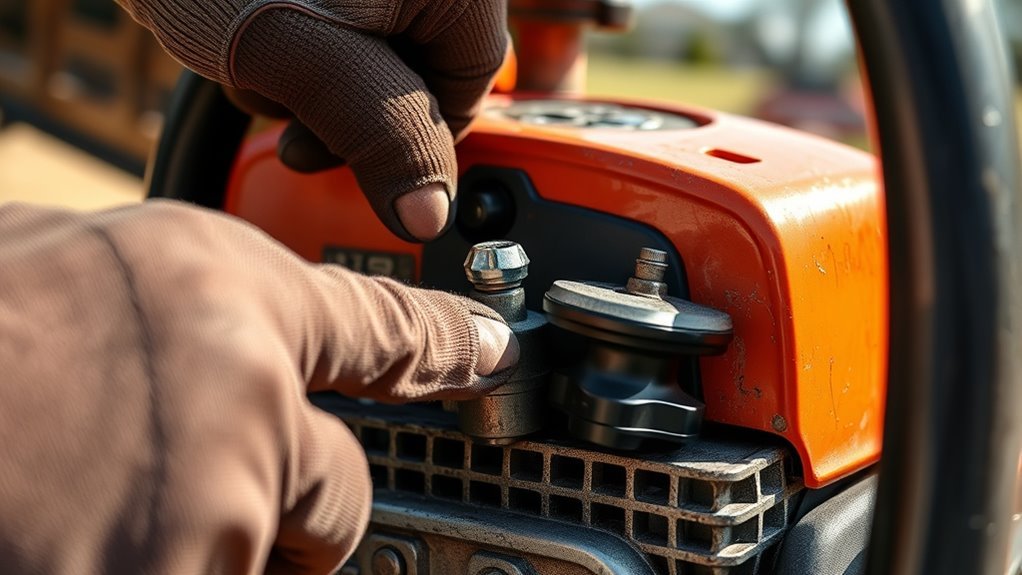
Before you adjust the carburetor, start the chainsaw and let it run for about five minutes to warm up the engine. This warm-up period guarantees the engine reaches its ideal operating temperature for accurate tuning.
Next, place the chainsaw on a stable, level surface to ensure a safe and precise adjustment process. Make sure the fuel tank is at least half full, maintaining consistent fuel flow during this procedure.
Once the engine is warmed up, turn it off before proceeding. Now, locate the three main adjustment screws on the carburetor body—these are labeled H (High), L (Low), and T (Idle).
Identifying these screws correctly is essential because they control fuel and idle levels, allowing you to fine-tune your chainsaw’s performance safely and effectively.
Adjust Low-Speed and Idle Screws for Smooth Operation

With the engine warmed up and the adjustment screws located, you can now focus on tuning the Low-Speed (L) and Idle (T) screws for smooth operation. Start by turning the idle screw clockwise until the chain just begins to move, then slowly turn it counterclockwise until the chain stops. This sets a proper idle speed.
Next, adjust the Low-Speed screw by turning it clockwise until the engine nearly stalls, then counterclockwise until the engine runs smoothly at low RPM. Fine-tune the L screw to achieve consistent, smooth acceleration as you open the throttle.
Your goal is for the engine to maintain a steady idle without stalling or the chain moving. Proper adjustment of these screws ensures your carburetor delivers balanced fuel, making your chainsaw run smoothly and reliably.
Fine-Tune High-Speed Screw for Optimal Performance
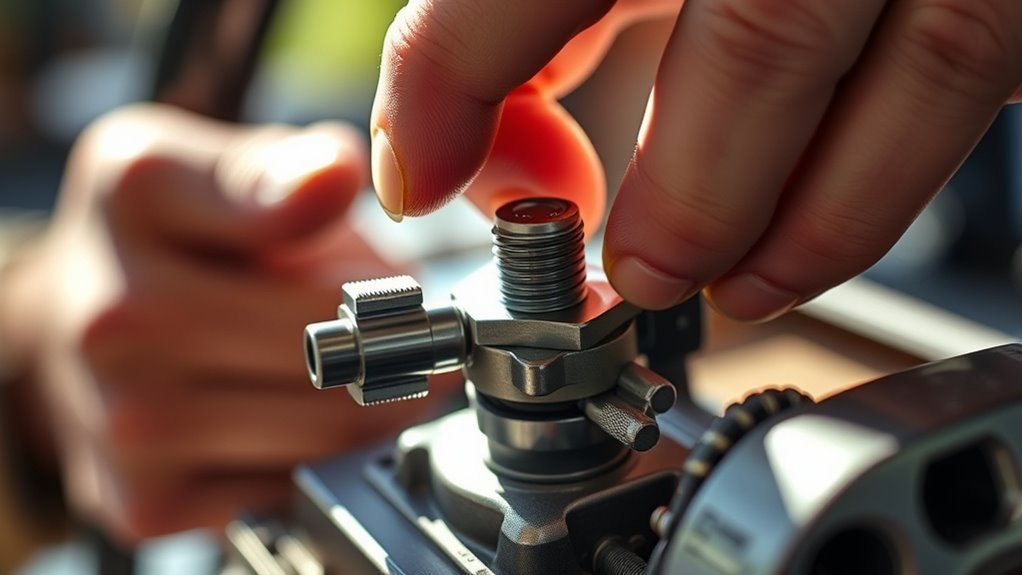
Although you’ve already tuned the low-speed and idle screws, fine-tuning the high-speed screw is crucial to maximize your chainsaw’s performance. Start by turning the high-speed screw clockwise to enrich the mixture and increase RPM or counterclockwise to lean it and decrease engine speed.
Adjust gradually, listening for a smooth running engine without hesitation at full throttle. Aim for the maximum RPM where you hear a slight “blubber” sound, then back off slightly for perfect carburetor adjustment.
Use a tachometer to confirm RPM stays within the manufacturer’s recommended range—typically around 12,000 RPM. Proper high-speed screw tuning ensures your chainsaw runs smoothly at full throttle without excessive smoke or engine stumbling, delivering the best power and throttle response for efficient cutting.
Frequently Asked Questions
How Do I Set My Carburetor to Factory Settings?
You set your carburetor to factory settings by seating the H and L screws clockwise. Then, back them out about 1 to 1.5 turns.
Next, warm up the engine and adjust the idle screw. After that, fine-tune everything based on how the engine responds.
It’s pretty straightforward once you get the hang of it! Just take your time and listen to the engine.
How to Properly Tune a Chainsaw Carburetor?
Imagine your chainsaw humming like a well-tuned orchestra. You’ll warm it up first, giving it a few minutes to get ready.
Then, adjust the low and high-speed screws carefully. Listen closely for a smooth idle as you make these tweaks.
Next, fine-tune everything until it sings perfectly without hesitation or the chain moving on its own. Easy, right? Just a little patience and your saw will be running like a dream.
How Do You Adjust the Air and Fuel Mixture on a Carburetor?
You adjust the air and fuel mixture by turning the low-speed (L) and high-speed (H) screws on the carburetor. Turn clockwise to lean the mixture, counterclockwise to richen it.
Keep adjusting until the engine runs smoothly. It might take a few tries to get it just right.
What Are the Screws for Adjustment on a Chainsaw Carburetor?
Imagine your chainsaw stalling mid-cut—that’s usually the Idle Speed screw acting up.
You’ve got three screws: Idle Speed, Low Speed (L), and High Speed (H). Each one adjusts the engine RPM and fuel mixture for smooth operation.
These screws help keep your chainsaw running just right, whether you’re idling or working full throttle.
Tweak them carefully, and your saw will perform like new every time.
Conclusion
Now that you’ve learned how to set your chainsaw carburetor in just three easy steps, you’re ready to keep your tool running smoothly and safely.
Did you know that poorly adjusted carburetors cause nearly 40% of small engine failures? Taking a few minutes to fine-tune yours can save you time, money, and frustration.
With a properly tuned carburetor, you’ll enjoy better performance and longer engine life every time you start cutting. Regular carburetor adjustment helps maintain optimal fuel efficiency and reduces harmful emissions.
So, don’t overlook this simple maintenance task. Setting your chainsaw carburetor correctly ensures your chainsaw runs reliably and efficiently, making your cutting jobs easier and safer. Keep your chainsaw in top shape by mastering these easy carburetor adjustment steps!