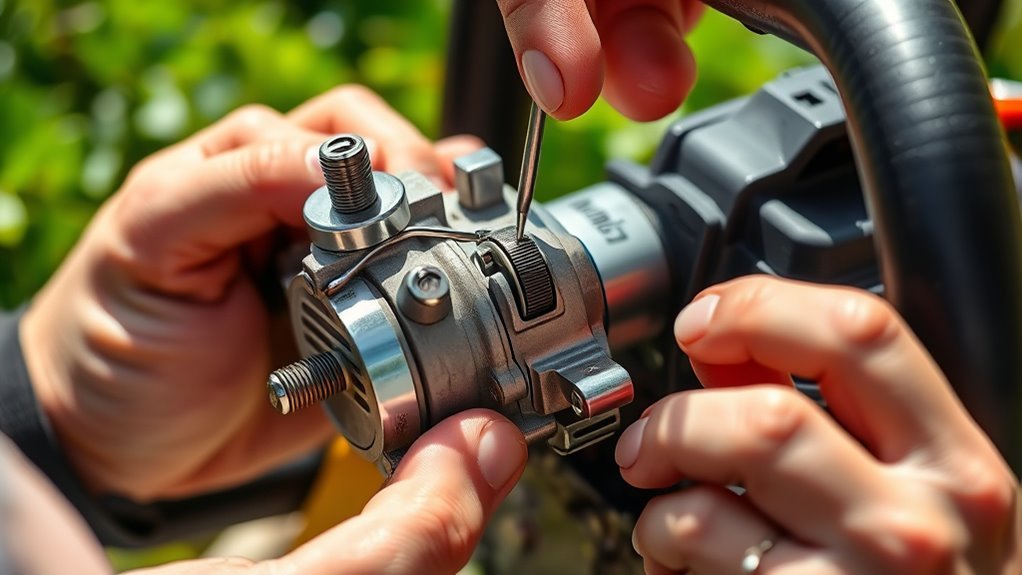
How to Adjust a Chainsaw Carburetor in 5 Easy Steps
To adjust your chainsaw carburetor, first make sure the engine is cool. Then, remove the air filter to get clear access to the carburetor. This step is essential for a smooth and accurate tuning process.
Next, locate the low-speed (L) and high-speed (H) screws on the carburetor. Gently turn both screws clockwise until they lightly seat, but don’t force them. After that, back each screw out about 1.5 turns to set your baseline.
Now, start the engine and let it warm up for a few minutes. Once it’s ready, adjust the low-speed screw to achieve a smooth idle. Take your time here; you want the engine running steadily without sputtering.
After that, fine-tune the high-speed screw. Turn it slowly to reach peak RPM without making the engine over-rev. Be cautious — pushing too far can cause damage.
Finally, test the idle and throttle response. If anything feels off, tweak the screws slightly until the chainsaw runs perfectly. Following these steps will help you master precise tuning and keep your chainsaw running efficiently.
Key Takeaways
- Cool the engine, remove the air filter, and locate the low-speed (L) and high-speed (H) adjustment screws.
- Lightly seat both screws clockwise, then turn them out 1.5 turns to set initial baseline positions.
- Warm up the engine for 3–5 minutes, then adjust the low-speed screw for smooth, stable idle without stalling.
- Fine-tune the high-speed screw by increasing RPM to peak, then slightly backing off to avoid over-revving.
- Verify idle speed with the chain brake engaged, adjust if needed, and test throttle response and spark plug color.
Prepare Your Chainsaw for Carburetor Adjustment
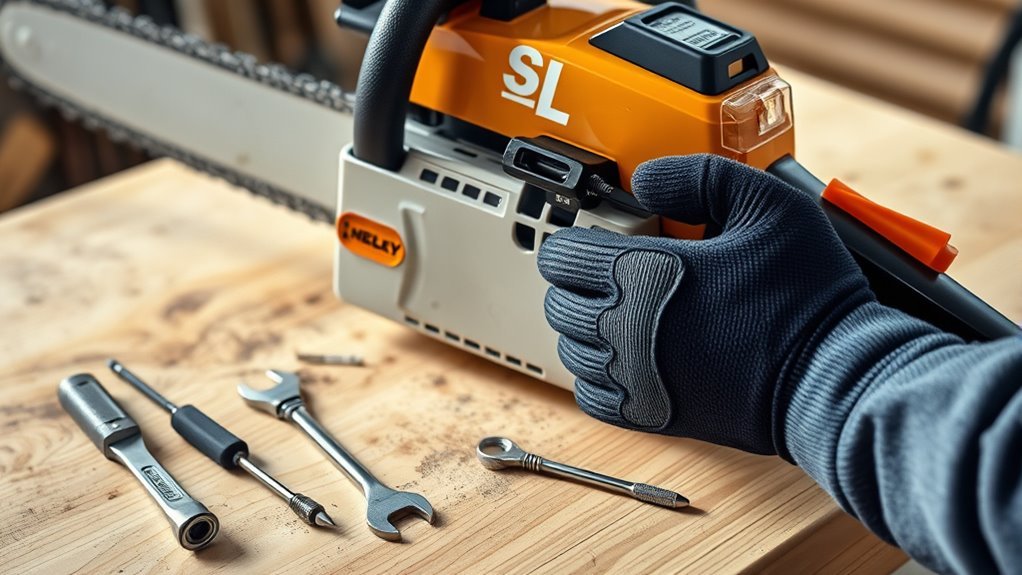
Before you begin adjusting the carburetor, make sure your chainsaw engine is completely cool. This helps you avoid burns and guarantees accurate tuning.
Start by removing the air filter cover and the air filter itself to access the carburetor easily. Check that your air filter is clean because a dirty one can cause inaccurate readings during adjustment.
Use fresh, properly mixed fuel to ensure consistent performance. Locate the low-speed jet and high-speed adjustment screws on your carburetor, which are usually detailed in your chainsaw’s manual.
Before making any fine-tuning, turn both screws about 1.5 turns out from fully seated. This sets your baseline for adjusting the idle and overall speed.
Proper preparation ensures your carburetor adjustment leads to smooth idling and ideal high-speed performance. It’s always worth taking the time to get these steps right.
Locate and Set Initial Positions of Adjustment Screws
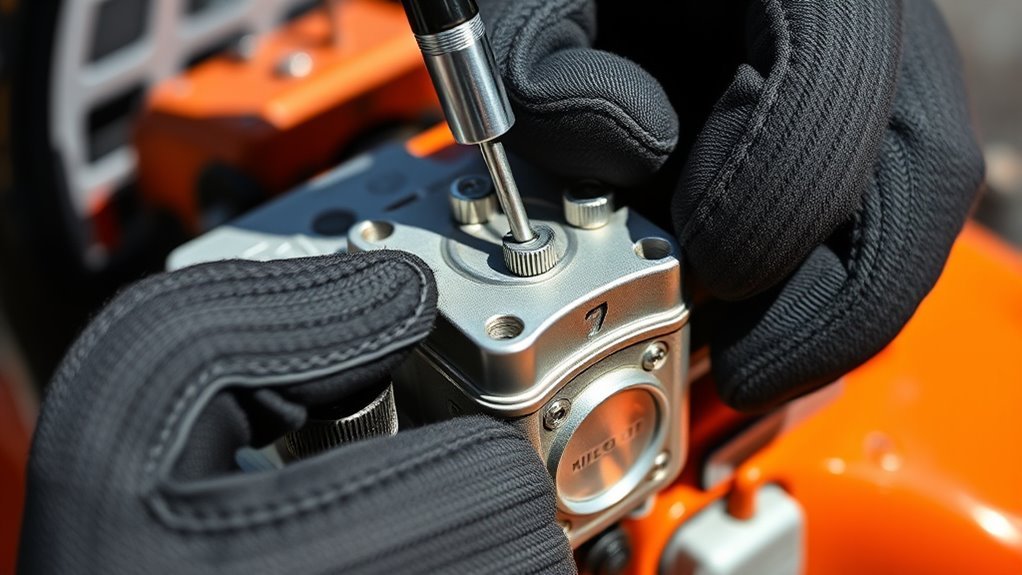
With the air filter removed and fresh fuel ready, you can locate the two main adjustment screws on your chainsaw’s carburetor: the Low Speed (L) and High Speed (H) screws. Both adjustment screws sit on the carburetor’s side, near the air filter cover, with slotted heads for easy turning.
To set a proper baseline, gently turn each screw clockwise until it’s lightly seated—don’t overtighten. From this baseline, set the initial setting by turning each screw out about 1.5 turns. This gives you a solid starting point for fine tuning.
Here’s what to focus on:
- Low speed screw controls idle and low throttle response
- High speed screw manages performance at full throttle
Always refer to the manual for specific screw positions and adjustments. This method guarantees your chainsaw runs smoothly from the start.
Warm Up the Engine and Adjust the Low-Speed Screw

Once the chainsaw is running, let it warm up for 3 to 5 minutes so the engine reaches its ideal temperature. This guarantees the engine hits its peak operating temperature before you adjust the low-speed screw.
Place the saw on a stable surface and engage the chain brake. Locate the idle screw marked “L” on the carburetor. Turn it clockwise until it lightly seats, then back out about 1.5 turns.
Now, adjust the low-speed screw to achieve a smooth idle where the engine runs steadily without stalling or surging. Proper carburetor adjustment here stabilizes your saw’s performance at low speeds.
| Step | Action | Result |
|---|---|---|
| Warm up the engine | Run for 3–5 minutes | Peak operating temp |
| Locate idle screw | Find screw marked “L” | Ready for adjustment |
| Adjust low-speed | Tune for smooth idle | Engine runs steadily |
Fine-Tune the High-Speed Screw for Optimal Performance
Although adjusting the low-speed screw sets a steady idle, you’ll need to fine-tune the high-speed screw to maximize your chainsaw’s cutting power and efficiency at full throttle. The high-speed screw controls your engine’s maximum RPM and fuel mixture, which is vital for peak performance.
Start by slowly turning the high-speed screw clockwise to raise RPM until it peaks. Then, turn the screw back slightly to avoid over-revving. If you hear a high-pitched scream or the saw running “rich,” just reduce RPM by turning the screw counterclockwise.
Keep these tips in mind while adjusting the carburetor:
- Use a tachometer to confirm maximum RPM matches manufacturer specs.
- Avoid setting the screw too lean to prevent engine damage.
- And don’t forget to confirm idle speed remains stable after your adjustments.
Test Idling and Make Final Carburetor Adjustments
How can you be sure your chainsaw is running at its best? First, make sure the saw is warmed up with a clean air filter installed. Listen to the idling saw; the chain should stop moving at idle.
If it doesn’t, adjust the carburetor’s idle screw to lower the RPM so the chain stops safely. Next, check throttle response—at full throttle, you should hear a steady, high-pitched scream indicating max RPM. If it’s irregular, fine-tune the high-speed screw.
After running the saw, inspect the spark plug: a light tan color means your fuel mixture is right, while dark or wet plugs suggest a rich mixture needing adjustment. Finally, test-cut small wood pieces to confirm smooth operation before finishing your tuning session.
Frequently Asked Questions
How to Properly Adjust Carbs on a Chainsaw?
You’ll warm up the chainsaw first. Then, turn the low-speed screw clockwise to increase RPM for a smooth idle.
Next, adjust the high-speed screw at full throttle. Make sure you get the max RPM without the engine bogging down or screaming. Easy, right?
How Do You Adjust the Air and Fuel Mixture on a Carburetor?
You adjust the air and fuel mixture by turning the Low Speed (L) and High Speed (H) screws. Turn clockwise to enrich the fuel, and counterclockwise to lean it out.
You want to aim for a smooth idle and a throttle that responds well. It might take a few tries, but you’ll get the hang of it!
How Do You Adjust the H and L on a Chainsaw?
You adjust the H screw at full throttle to set max RPM, turning clockwise to lean or counterclockwise to richen.
Adjust the L screw at idle, turning clockwise to lean or counterclockwise to smooth idling.
It’s pretty straightforward once you get the hang of it. Just remember, a little tweak at a time goes a long way!
How Do I Set My Carburetor to Factory Settings?
You set your carburetor to factory settings by lightly seating the L, H, and T screws, then backing each out about 1 to 1.5 turns.
Warm the engine, then fine-tune idle for smooth running. It’s a simple process that helps get your engine running just right.
Conclusion
Now that you’ve adjusted your chainsaw’s carburetor, you’re ready to tackle any cutting job with smooth, powerful performance. Remember, fine-tuning those screws guarantees your engine runs efficiently and lasts longer.
Isn’t it satisfying to hear your chainsaw roar perfectly every time? With just a bit of patience and these simple steps, you’ve taken control of your tool’s power.
Keep practicing, and you’ll master carburetor adjustments in no time! Proper carburetor tuning not only boosts your chainsaw’s performance but also extends its lifespan, making every cut easier and safer. So, don’t hesitate to adjust your chainsaw carburetor whenever it feels sluggish or hard to start. This quick maintenance step ensures your chainsaw runs smoothly and delivers the power you need for any job.