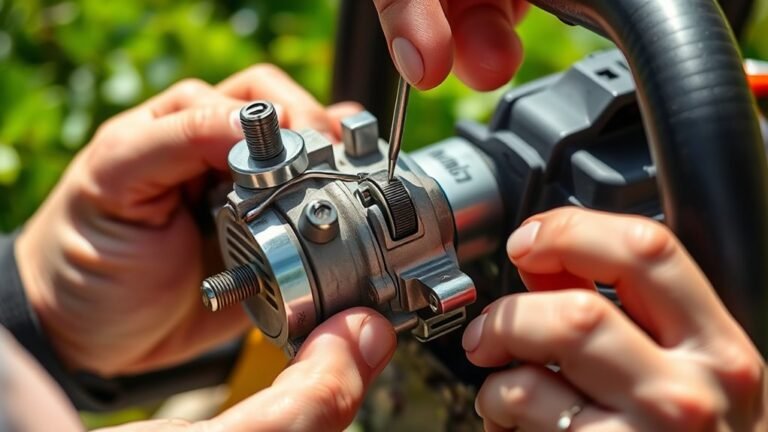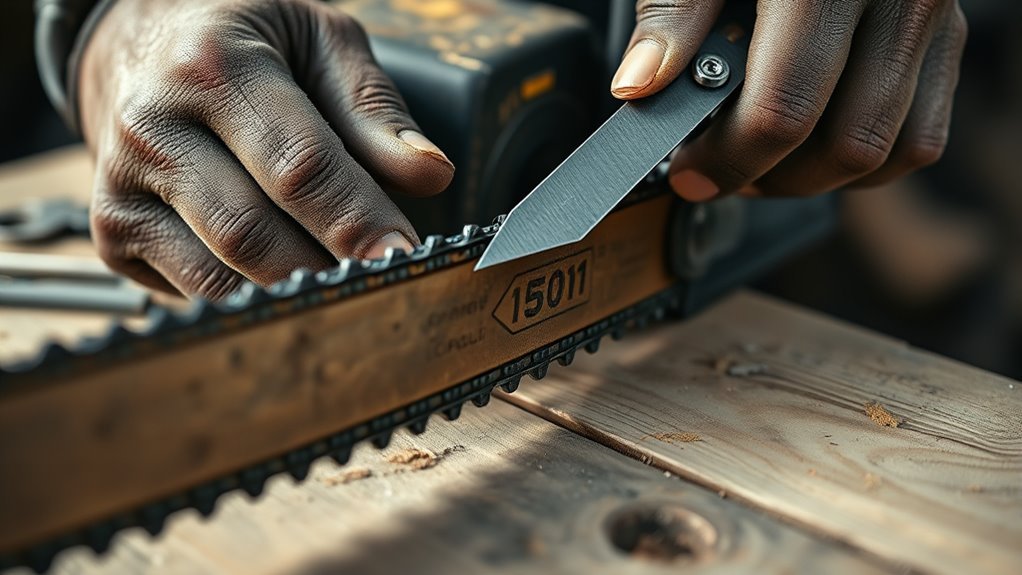
What Is the Best Angle to Sharpen a Chainsaw Chain in 10 Steps
You’ll get the best results sharpening your chainsaw chain at a precise 30° angle, balancing sharpness and durability. Using the right angle is key to keeping your chain cutting efficiently without wearing out too fast.
Start by safely prepping your saw and wearing protective gear. Safety first, always! Then grab the right round file and a filing guide to keep those angles consistent.
Mark a master tooth to match all cutters so every tooth is uniform. It’s important to keep tooth length even and adjust depth gauges properly for smooth cuts.
Follow steady, even strokes while filing—no rushing! Stick with these steps, and you’ll soon master maintaining a sharp, long-lasting chain that works like new every time.
Key Takeaways
- The optimal sharpening angle for chainsaw chains is typically around 30° for a balance of sharpness and durability.
- Maintain consistent filing angles using a guide or jig to ensure even tooth wear and safe, straight cuts.
- Adjust the top plate angle between 25° and 35°. Steeper angles cut faster but dull quicker.
- Mark a master tooth with a felt tip pen to match all cutters’ angles and lengths uniformly during sharpening.
- Use a round file matching the chain pitch. Apply steady, even pressure while filing at the correct angle.
Signs Your Chainsaw Chain Needs Sharpening

If you notice your chainsaw producing fine sawdust instead of large wood chips, it’s a clear sign that the chain needs sharpening. A dull chain struggles with cutting, resulting in sawdust rather than clean chips.
You might also see smoke coming from the chain area, even when lubrication and tension are spot on—that’s another indicator the chain’s teeth are dull or damaged. When your saw pulls to one side or the cut isn’t straight, it’s time to sharpen the chain.
Plus, if the saw chatters, bounces, or feels harder to control, the cutting teeth likely aren’t even or sharp enough. In conclusion, take a close look at the teeth—uneven or elongated shapes mean your chain has dulled and needs sharpening to maintain efficient, safe cutting.
Choosing the Correct Sharpening Angle
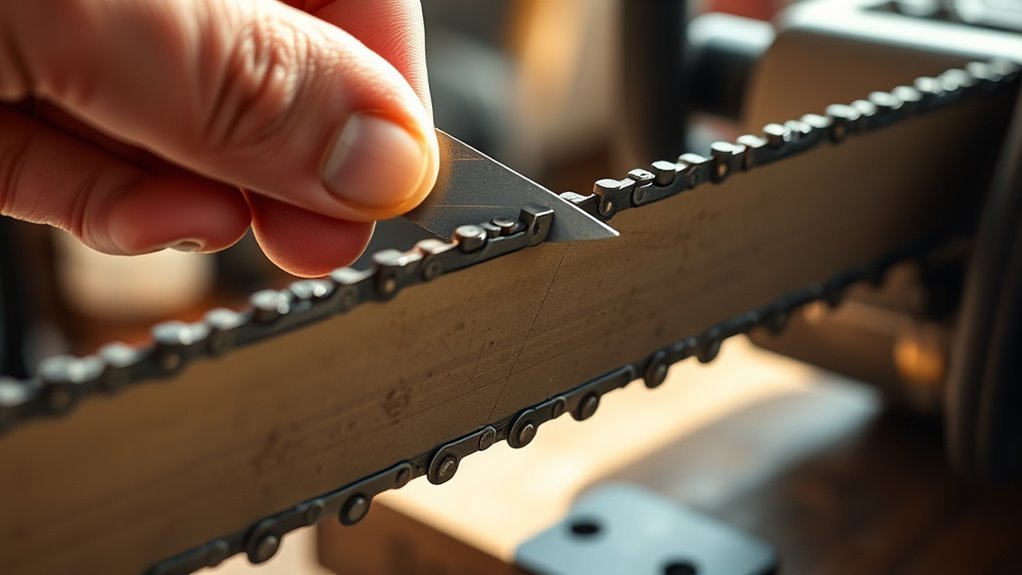
You’ll want to pick the right sharpening angle to match the type of wood you’re cutting and how you use your chainsaw. Most experts suggest a 30° angle for a good balance between sharpness and chain life.
Adjusting the angle slightly can speed up cuts or extend your chain’s durability depending on whether you’re working with hard or soft wood. It’s a simple tweak that can make a big difference!
Angle Impact on Cutting
Although selecting the right sharpening angle might seem minor, it directly impacts your chainsaw’s cutting efficiency and chain longevity. The sharpening angle, often between 25° and 35°, defines the top plate angle of each cutting edge.
A steeper top plate angle creates a sharper cutting edge, allowing the chain to cut faster and more aggressively. However, this also means the edge dulls quicker. On the other hand, a smaller sharpening angle produces a more durable edge but cuts less aggressively.
Keeping the sharpening angle consistent ensures your chain will cut predictably and last longer. Understanding how the top plate angle affects cutting helps you balance speed and durability, so your chainsaw performs effectively under various cutting conditions.
Recommended Sharpening Angles
When choosing the correct sharpening angle, most chainsaw chains fall between 25° and 35°, with 30° being the standard for general use. You’ll want to maintain consistent sharpening angles to keep the chain teeth aligned with their original factory settings.
Steeper angles, like 35°, create sharper cutting edges that cut aggressively but dull faster. On the other hand, shallower angles, around 25°, give longer chain life but a less aggressive cut.
It’s important to follow the recommended angle for your specific chain type—semi-chisel or full chisel—as manufacturers often specify the ideal sharpening angle. Sticking to the right angle guarantees your cutting edges perform predictably, preserving the chain’s efficiency and safety during operation.
Always refer to your chainsaw’s guidelines before adjusting sharpening angles. This way, you’ll keep everything running smoothly and safely.
Adjusting Angle for Wood
Selecting the right sharpening angle depends largely on the type of wood you’ll be cutting. Sharpening angles and top plate angles directly influence how your cutting teeth perform on different wood types.
Hardwoods like oak require steeper angles, around 35°, for efficient cutting, while softer woods such as pine do well with 25° to 30°. Here’s what to contemplate:
- Steeper top plate angles increase cutting aggressiveness but dull the chain faster.
- Shallower angles prolong chain life but cut less aggressively.
- Always follow manufacturer-recommended sharpening angles for consistent performance.
- Test on scrap wood to find the best angle for your specific wood types.
Adjust your sharpening angle based on wood hardness to optimize cutting speed and chain durability. It really helps to dial it in for the wood you’re working with!
Preparing Your Chainsaw and Safety Gear

Before you start sharpening your chainsaw chain, make sure you disconnect the power source or remove the spark plug to prevent accidental starts.
Always disconnect the power or remove the spark plug before sharpening your chainsaw chain.
Next, put on proper safety gear—gloves, safety glasses, and a dust mask—to protect yourself from flying debris and sharp chain fragments.
Secure your chainsaw on a stable work surface or clamp it firmly in a vise to keep it from moving while you work.
Inspect the chainsaw chain carefully for any damage, cracks, or excessive wear that could affect the sharpening angle or overall safety.
Finally, clean the chain thoroughly using a brush or compressed air to remove dirt, oil, and sawdust.
This preparation guarantees a safer, more precise sharpening process.
Selecting the Right File and Guide
After preparing your chainsaw and ensuring your safety gear is in place, the next step is to pick the right file and guide for sharpening. Choosing the correct tools guarantees you maintain the proper angle and achieve a sharp, efficient cutter.
Focus on these key points: select a round file matching your chain’s pitch (e.g., 3/16″ for .325″ pitch). Use a filing gauge designed for your chain type and the recommended sharpening angle (commonly 30° or 35°).
Attach the guide securely to the bar or chain, aligning it precisely with the cutter angle. Make sure the file extends about 20% above the cutter’s top to maintain the correct filing angle.
And don’t forget—regularly inspect and replace worn files and guides. That way, your chainsaw keeps cutting smoothly and safely every time.
Marking the Master Tooth for Consistency
Although sharpening each tooth might seem straightforward, marking the master tooth with a felt tip pen guarantees you keep every cutter consistent in angle and length. This marking acts as a essential reference point, helping you maintain the correct sharpening angle across the entire chain.
By clearly marking the master tooth, you ensure consistency in both filing angle and tooth length, which is critical for effective cutting performance. Use the marked master tooth as your guide to align your file or grinding tool for every subsequent tooth.
Regularly check back to this master tooth during the sharpening process to confirm all teeth match its angle and length. Proper marking simplifies sharpening, reduces errors, and extends your chainsaw chain’s lifespan by promoting uniformity.
Filing the Cutters at the Proper Angle
When filing your chainsaw cutters, you’ll want to keep the angle between 25° and 35°.
Ideally, aim for about 30° for most jobs. Staying consistent with this angle is key, so using a guide can really help you maintain uniform sharpness across all cutters.
Keeping this precision guarantees your chain cuts efficiently and lasts longer. It’s worth taking the time to get it right!
Optimal Filing Angles
To sharpen your chainsaw cutters effectively, you need to maintain the proper filing angle, typically between 25° and 35°. Thirty degrees is ideal for most tasks.
Using the correct filing angles guarantees your cutters perform efficiently and last longer. An angle gauge or filing guide helps you keep this precise angle during sharpening.
Remember, sharpening at 35° yields aggressive, sharp cuts but dulls faster. Filing at 25° extends chain life with less aggressive cutting.
Consistent filing angles prevent uneven wear on cutters. Plus, proper angles reduce operator fatigue and improve cutting efficiency.
Angle Consistency Importance
Maintaining a consistent sharpening angle is crucial because it guarantees your chainsaw cuts smoothly and wears evenly. When you keep the angle steady on every cutter, the chain performs uniformly, preventing crooked cuts and uneven wear.
Even slight deviations of a few degrees can slow cutting speed, reduce chain durability, and compromise safety. Consistency in angle simplifies the sharpening process, delivering predictable results and extending the chain’s life.
To achieve this, consider using a guide or jig—it helps you maintain precise, repeatable angles and minimizes operator error. By focusing on angle consistency during sharpening, you ensure your chain stays efficient, safe, and long-lasting.
This makes your cutting tasks easier and more reliable every time.
Maintaining Uniform Tooth Length
Although sharpening your chainsaw chain, you need to keep all cutters at the same length to guarantee smooth, even cutting. Achieving uniform tooth length requires attention to detail and consistency.
Use the depth gauge setting to measure each cutter and adjust them as needed. Employ a steady filing technique to remove equal amounts of metal from every tooth.
Here are key tips for maintaining uniform tooth length while sharpening your chainsaw:
- Mark the first tooth as a master and match all others to its length and angle.
- Apply the same number of strokes and pressure on each cutter.
- Regularly check cutter lengths during the process to avoid unevenness.
- Use the depth gauge setting consistently for precise measurement and adjustment.
This approach ensures balanced cutting and extends your chain’s lifespan. Keep at it, and you’ll notice the difference in performance!
Checking and Adjusting the Depth Gauges
Since the depth gauges control how much wood each cutter removes, checking and adjusting them is essential for efficient cutting. After sharpening the chain, use a depth gauge tool or filing gauge to measure each depth gauge’s height relative to the cutting teeth.
If any depth gauges stick out beyond the recommended height, carefully file them down to ensure the chain is specifically designed for balanced, effective cutting. Use smooth, horizontal filing strokes to avoid removing too much material or creating uneven surfaces.
Maintaining a consistent depth gauge height across all cutters promotes uniform cutting performance and extends the chain’s life. Always double-check the depth gauges after sharpening the chain to confirm they provide proper clearance for ideal cutting efficiency.
Tips for Effective and Safe Sharpening
After you’ve checked and adjusted the depth gauges, it’s important to focus on sharpening the chain safely and effectively. Proper sharpening at the correct angle guarantees your chainsaw cuts smoothly and lasts longer.
Keep these tips in mind to maintain safety and precision:
- Always wear gloves and eye protection to guard against metal shards during sharpening.
- Use the right sharpening angle, typically between 25° and 35°, for consistent cutting edges.
- Secure the chain firmly in a vice or on a workbench to maintain control and accuracy.
- Apply steady, even pressure with your file, avoiding excessive force to prevent uneven wear.
Maintaining Your Chain for Longer Life
To keep your chainsaw chain performing at its best, you need to maintain it regularly by inspecting and filing the depth gauges, cleaning off dirt and grime, and ensuring proper lubrication. Consistently using the correct filing angle—typically between 25° and 30°—with your sharpener prevents uneven wear and maintains cutting efficiency.
Avoid over-filing or thinning the cutting edges, as this weakens the teeth and shortens chain life. Regular chain maintenance also involves keeping the chain clean to minimize dirt buildup that dulls the teeth faster.
Finally, store your chain in a dry, protected place to prevent rust and corrosion, ensuring longer durability. By following these steps, you’ll extend your chain’s lifespan and keep your saw cutting smoothly every time.
Frequently Asked Questions
What Angle Should a Chainsaw Sharpener Be Set At?
You should set your chainsaw sharpener at 30° for general use, balancing sharpness and durability.
For hardwood, try 25°. Keep the angle consistent to guarantee efficient cutting and prolong your chain’s life.
This way, your chainsaw stays sharp longer and works better every time you use it.
Do You Push or Pull When Sharpening a Chainsaw?
You push when sharpening a chainsaw chain. Always push the file forward along the tooth, applying gentle pressure and keeping a consistent angle to guarantee a sharp, even edge.
Pulling can dull and damage the cutter. So, it’s best to avoid pulling the file back. Just keep it moving forward smoothly for the best results.
What Angle Cuts the Fastest on a Chainsaw Chain?
Sharp speed soars at a 30° to 35° angle. You’ll cut quicker with this consistent, clean, and carefully crafted edge.
Keep it keen, and you’ll conquer cutting challenges with confidence and continuous cutting charm.
How to Get a Chainsaw Really Sharp?
You get your chainsaw really sharp by filing each tooth at a consistent 30° to 35° angle with the correct round file. Make sure to use smooth, steady strokes for the best results.
Also, don’t forget to regularly adjust the depth gauges. This helps keep the cutting balanced and efficient. It might seem like a bit of work, but it really pays off!
Conclusion
Sharpening your chainsaw at the right angle keeps it cutting smoothly and safely. Imagine Jake, who struggled with a dull chain until he sharpened it consistently at 30 degrees—his cuts became faster and cleaner.
This saved him hours on his weekend projects. By following these steps and maintaining your chain regularly, you’ll boost performance and extend its life.
Don’t let a dull chain slow you down. Sharpen smart and work smarter every time, using the best angle to sharpen your chainsaw chain for optimal results.