How to Adjust a Chainsaw Carburetor in 10 Easy Steps
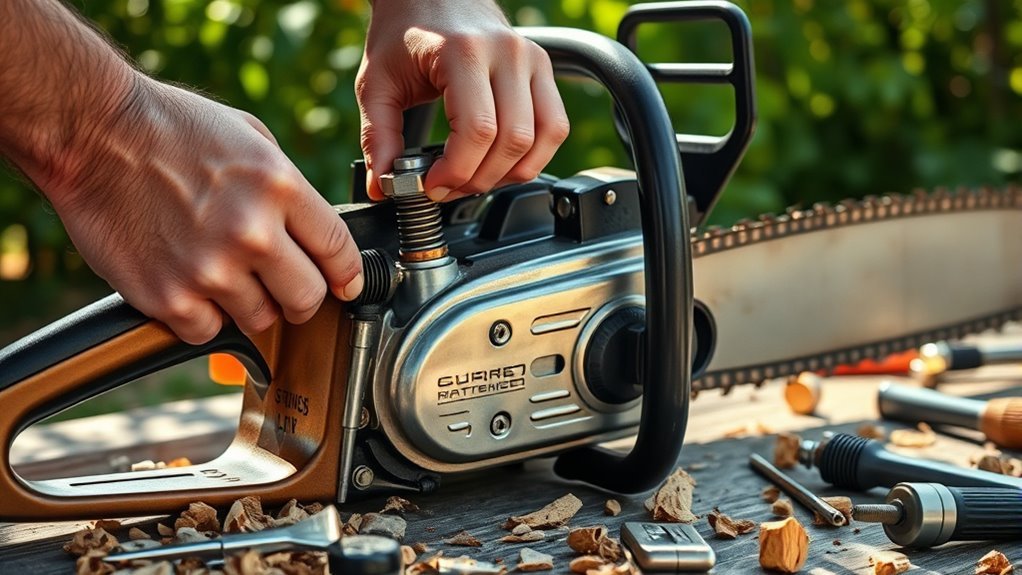
To adjust your chainsaw carburetor in 10 easy steps, first gather a screwdriver and wear safety gear. Removing the air filter will help you find screws labeled “L,” “H,” and “T.” These screws control the fuel mixture and idle speed, which are key for smooth operation.
Next, warm up your chainsaw to get it ready for adjustments.
Then, tweak the screws gradually—turning clockwise raises RPMs, while turning counterclockwise lowers them. Aim for a smooth idle, quick throttle response, and no chain movement when the saw is at rest.
Make sure to tighten the screws securely after tuning.
Don’t forget to check all safety features before using your chainsaw.
Keep practicing these steps to master precise carburetor tuning for top performance every time.
Key Takeaways
- Identify and locate the carburetor adjustment screws labeled “L,” “H,” and “T” by removing the air filter or engine cover.
- Warm up the engine for about 5 minutes before making initial carburetor adjustments for accurate tuning.
- Adjust the low-speed (L) and high-speed (H) screws in small increments to optimize fuel mixture and engine performance.
- Fine-tune the idle (T) screw to ensure the chain remains stationary and the engine idles smoothly.
- Secure all screws, reassemble covers, and perform safety checks before operating the chainsaw.
Gather the Necessary Tools and Safety Gear
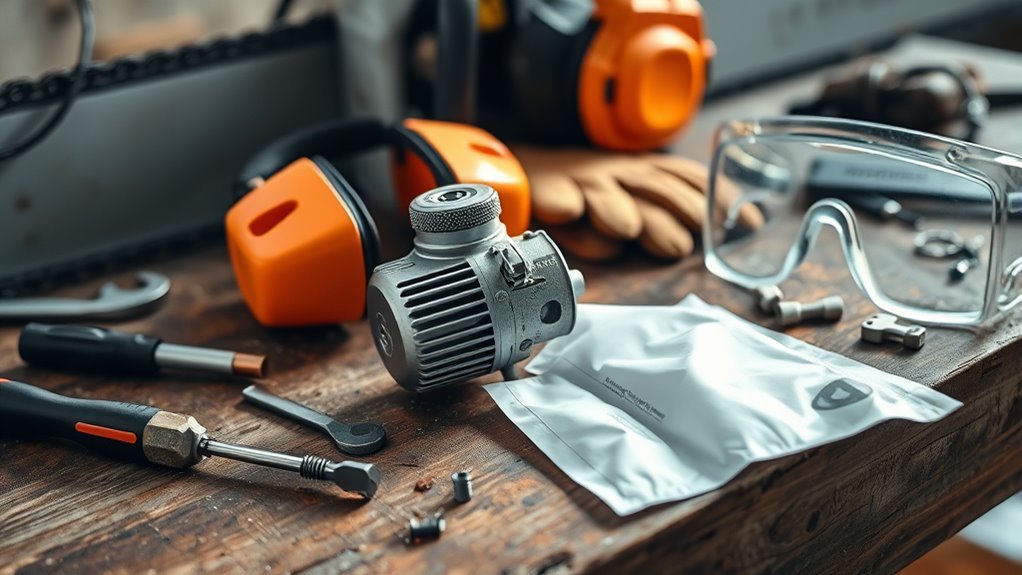
Before you begin adjusting your chainsaw carburetor, make sure you have the right tools and safety gear on hand. You’ll need a flat-head screwdriver or a specialized carburetor adjustment tool compatible with your model.
Always wear protective gloves and safety goggles to guard against fuel spills and debris. Confirm the chainsaw is turned off and the engine is cool before you remove any covers or attempt to access the carburetor screws.
Keep a clean cloth and a small container nearby to catch any fuel drips during the process. Using adequate lighting—and a magnifying glass if possible—will help you clearly see the screws labeled “L,” “H,” and “T.”
Having everything prepared makes accessing and adjusting the carburetor safer and more efficient. It’s just easier to get the job done when you’re all set up.
Locate the Carburetor Adjustment Screws
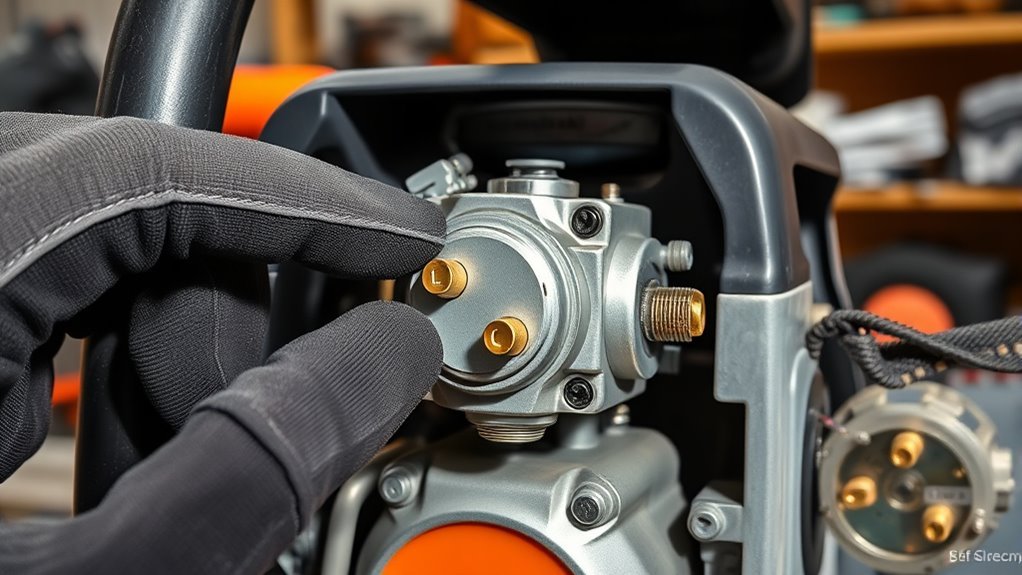
Where exactly do you find the carburetor adjustment screws on your chainsaw? These small screws are usually located on the side or top of the carburetor body, near the engine.
To access them, start by removing the air filter or engine cover with a screwdriver or socket wrench, depending on your model. The screws are often tiny, sometimes recessed, so you might need a precision screwdriver or a specialized carburetor adjustment tool.
They’re typically marked with “L,” “H,” or “T” to indicate their function. Always make sure your chainsaw is turned off and cooled before you begin.
Locating these carburetor adjustment screws is a vital first step to properly tuning your chainsaw’s engine for peak performance.
Identify Each Carburetor Screw and Its Function

Once you’ve located the carburetor adjustment screws, it’s important to know what each one does to tune your chainsaw correctly. The L screw controls the low-speed mixture, affecting how your engine runs at idle and during initial throttle.
The H screw manages the high-speed mixture, which impacts the maximum power and engine speed when you’re at full throttle. Lastly, the idle screw—often labeled T or LA—adjusts the throttle opening at rest, setting your chainsaw’s idle speed.
Understanding these screws helps you perform precise carburetor tuning, ensuring ideal engine performance and fuel efficiency. Identifying and adjusting each screw properly prevents engine issues and keeps your chainsaw running smoothly.
Warm Up the Chainsaw Engine Properly
Although it might be tempting to start adjusting the carburetor right away, you need to warm up the chainsaw engine properly to get accurate results.
The engine must reach its operating temperature to guarantee consistent performance throughout the tuning process. Here’s how to warm up your chainsaw engine effectively before adjusting carburetor settings:
- Pull the starter cord multiple times gently, avoiding aggressive revving.
- Let the engine idle for about 5 minutes to stabilize internal components.
- Keep the chainsaw on a stable surface with the chain disengaged or stationary.
- Avoid applying heavy loads or revving during warm-up to prevent uneven temperature distribution.
Following these steps helps you warm up the chainsaw engine properly. This way, you ensure precise adjustments and prime carburetor performance.
Adjust the Low-Speed Screw for Smooth Idle
Before you adjust the low-speed screw, make sure the engine is warmed up and idling. Start your low-speed adjustment by turning the screw in small quarter-turn increments.
Turning it clockwise will lean the mixture, raising the engine RPM at idle, while turning it counterclockwise enriches the mixture, lowering RPM. Listen carefully as you adjust to achieve a smooth, stable idle without sputtering or stalling.
Check that the chain remains stationary; if it moves, slightly tighten the idle screw or tweak the low-speed screw accordingly. After each adjustment, rev the engine briefly to confirm it accelerates smoothly without hesitation or bogging down.
With patience and incremental adjustments, you’ll set the low-speed screw perfectly for a reliable, smooth idle and ideal engine performance.
Fine-Tune the High-Speed Screw for Optimal Power
Now that you’ve adjusted the low-speed screw, locate the high-speed (H) screw on your carburetor.
You’ll fine-tune this screw to achieve maximum power at wide-open throttle (WOT). Make small adjustments and listen carefully for smooth, strong engine response without over-revving.
Take it slow and steady—that way, you’ll get the best performance without causing any damage. Keep tweaking until the engine feels just right!
Identifying the H Screw
Where can you find the H screw on your chainsaw carburetor? The H screw, or high-speed adjusting screw, is typically located on the side of the chainsaw carburetor. It controls the fuel mixture when the engine runs at full throttle, directly impacting power output.
To identify it, look for an adjusting screw labeled “H” or marked high-speed. It’s usually smaller than the idle (L) screw and positioned near the top or side of the carburetor body.
Often, it requires a flathead screwdriver for turning. Understanding the H screw’s location helps you fine-tune the fuel mixture for smooth revving.
Adjusting for WOT Power
When you adjust the high-speed (H) screw, you’re fine-tuning the fuel mixture to get the best power at Wide Open Throttle (WOT). Start by turning the high-speed screw in small increments—about a quarter turn—then rev the engine briefly to hear how it responds.
Turning the screw clockwise enriches the mix, boosting power, while turning it counterclockwise leans the mix and lowers RPM. Listen closely at WOT for a smooth, steady engine tone without sputtering or hesitation.
If the engine screams or revs too high, loosen the H screw slightly; if it bogs down, tighten it carefully. Properly adjusting the screw guarantees maximum power, smooth acceleration, and minimal engine flutter or four-stroking at WOT.
Set the Idle Speed Screw for Stable Engine Operation
Although adjusting the idle speed screw may seem simple, it plays a crucial role in keeping your chainsaw’s engine running smoothly at rest.
The idle speed screw, often marked “T” or “LA,” controls the engine’s RPM when the chainsaw isn’t being used. You’ll want to turn the adjusting screw clockwise to increase idle speed or counterclockwise to decrease it.
Adjust carefully until the engine runs smoothly without stalling or revving too high.
Keep these tips in mind:
- Make small, incremental turns on the idle speed screw
- Ensure the chain doesn’t move at idle for safety
- Listen for a steady, smooth engine sound
- Recheck the engine’s response after each adjustment
This ensures stable engine operation and safe handling when idling.
Test the Chainsaw’s Acceleration and Throttle Response
Since proper throttle response is essential for safe and efficient chainsaw operation, you’ll want to rev the engine for about five seconds to observe how smoothly it accelerates. Listen carefully for hesitation, bogging, or lag, which signal that you may need to adjust the high-speed screw.
The engine should reach full throttle quickly without sputtering or stalling, ensuring excellent acceleration. If the engine screams excessively or accelerates sluggishly, tweak the adjust screw to fine-tune performance.
A clean rev and steady RPMs when the throttle is fully engaged indicate a well-set carburetor. Just keep an ear out for anything unusual during acceleration—it’ll tell you if something’s off.
| Feeling | Observation | Action Needed |
|---|---|---|
| Confident | Smooth acceleration | No adjustment |
| Concerned | Lag or bogging | Adjust high-speed screw |
| Frustrated | Sputtering or stalling | Recheck adjustments |
Make Final Carburetor Adjustments Based on Engine Feedback
As you listen closely to your chainsaw’s engine at both idle and full throttle, you’ll want to make final carburetor adjustments that guarantee a smooth, consistent tone without hesitation or sputtering. Focus on fine-tuning the fuel and air mixture by carefully adjusting the high-speed (H) and low-speed (L) screws.
Make small, quarter-turn changes and check how the engine responds each time. Adjust the H screw to maximize power without engine screaming or excessive RPM.
Tune the L screw for steady idle and quick acceleration. Confirm the chain stays still when idling to avoid stalling.
Also, confirm smooth operation at all speeds before finalizing adjustments. This approach ensures your carburetor delivers ideal fuel-air balance for efficient, reliable performance.
Secure All Screws and Perform Safety Checks
Once you finish adjusting, make sure to tighten all screws securely. This will help prevent air leaks and keep your engine running smoothly.
Don’t forget to check that the fuel cap, air filter cover, and side covers are properly in place. It’s a small step but really important for safety and performance.
Finally, perform a thorough safety inspection. Make sure the chain brake, throttle lock, and chain are disengaged before you start the saw. Better safe than sorry!
Tighten Adjustment Screws
Before you start the engine, make sure you tighten all adjustment screws securely to prevent air leaks and guarantee consistent carburetor performance. When adjusting this screw, always turn the screw clockwise until it’s snug, but don’t over-tighten.
Use a screwdriver with a firm grip and avoid stripping threads. To ensure correct settings, check your owner’s manual for the recommended torque or position after turning the screw.
- Confirm every screw is properly seated
- Avoid excessive force while tightening
- Re-secure screws after final adjustments
- Inspect the carburetor area for loose parts
Conduct Safety Inspections
After tightening the adjustment screws, double-check that every screw and cover is firmly secured to prevent leaks or parts coming loose during operation. Before testing your carburetor adjustments, check things like the chain brake and throttle trigger to ensure they disengage and work properly.
Inspect the chain and bar for proper mounting and debris removal. Also, verify the fuel system for leaks or cracks, and place the saw on a stable surface.
Once you start the saw, listen for unusual noises or vibrations. Then turn it off and confirm all screws and covers remain tight for safety.
| Item to Check | What to Verify |
|---|---|
| Screws & Covers | Firmly tightened |
| Chain Brake & Trigger | Proper disengagement |
| Chain & Bar | Correct mounting, no debris |
| Fuel System | No leaks or cracks |
| Saw Stability | Stable surface placement |
Frequently Asked Questions
How to Tell if a Chainsaw Is Running Too Lean?
You’ll know your chainsaw runs too lean if it revs unusually high, hesitates on acceleration, overheats, or sounds like it’s screaming at full throttle.
You might also notice little black smoke and a hot metal smell.
These signs usually mean the fuel mixture isn’t quite right. It’s like your chainsaw is gasping for the right balance. Keep an eye out for these symptoms to avoid damage.
How to Reset Carburetor Screws?
To reset carburetor screws, turn each clockwise gently until they seat, then back them out 1-2 turns. Mark their position, warm the engine, and adjust slowly to avoid damage while tracking changes carefully.
It’s pretty straightforward once you get the hang of it. Just take your time with each adjustment, and you’ll keep everything running smoothly.
How to Set a Chainsaw Carb?
Think of tuning a chainsaw like tuning a wild stallion—start by warming it up, then gently twist the carburetor screws to balance speed and idle.
This helps ensure smooth power without stalling or choking under pressure. Just take it slow and steady.
How to Rebuild a Chainsaw Carb?
You’ll remove the carburetor, carefully disassemble it, and clean all parts with carb cleaner. Replace worn components, inspect for damage, then reassemble tightly.
Finally, test and fine-tune it for smooth chainsaw performance. It’s a bit of a process, but taking your time really pays off!
Conclusion
Now that you’ve adjusted your chainsaw carburetor, you know that “a stitch in time saves nine.” Taking the time to fine-tune those screws guarantees your saw runs smoothly and safely, preventing bigger issues down the road.
Remember to double-check all screws are secure and perform safety checks before each use. With these simple steps, you’ll keep your chainsaw in top shape and ready for any job that comes your way.
Adjusting your chainsaw carburetor might seem tricky at first, but once you get the hang of it, it’s a game changer. Regularly tuning the carburetor ensures optimal engine performance, better fuel efficiency, and extends the life of your chainsaw. So, stick to these easy steps and maintain your tool like a pro!