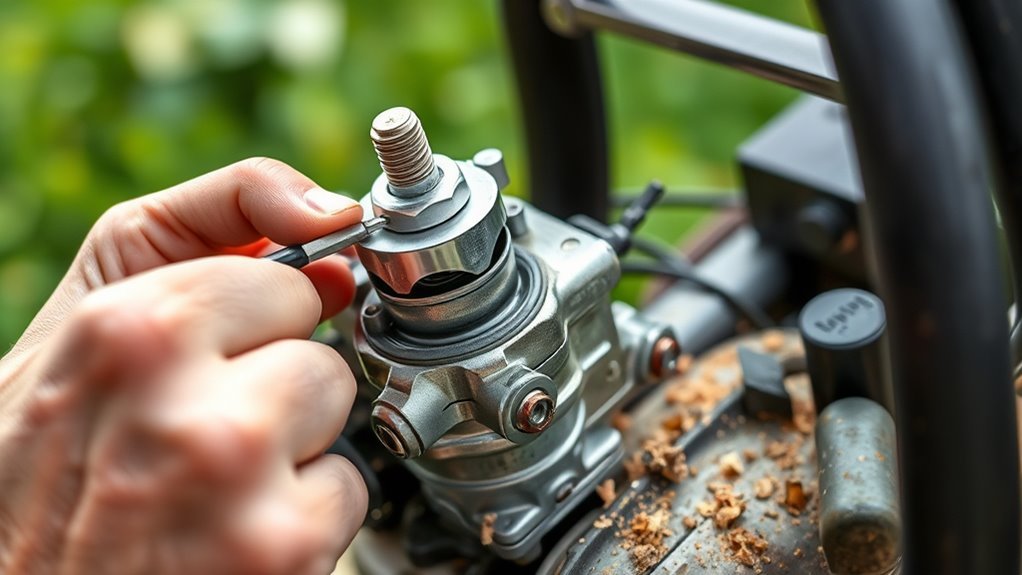
How to Adjust Chainsaw Carb in 5 Easy Steps
To adjust your chainsaw carburetor in 5 easy steps, you’ll need a few tools: a flathead screwdriver, a wrench, gloves, and goggles for safety. Adjusting the carburetor is key to keeping your chainsaw running smoothly and efficiently.
When your chainsaw isn’t performing well, tweaking the carb can make a big difference.
Start by warming up the engine. Let it idle for about five minutes so it’s ready for adjustment.
Next, locate the carburetor screws labeled “L,” “H,” and “T.” These control different aspects of the fuel mixture and idle speed.
Adjust the “L” screw first to set the low-speed mixture and idle. Turn it slowly until the chainsaw runs smoothly without sputtering.
After that, fine-tune the “H” screw to optimize high-speed performance. Keep adjusting carefully to avoid over-revving.
With these simple steps, you’ll get ideal results and maintain your chainsaw with confidence. It’s easier than you think!
Key Takeaways
- Warm up the chainsaw engine by running it idle for about 5 minutes on a stable surface. This helps the engine reach the right temperature for adjustments.
- Locate the carburetor adjustment screws labeled “L,” “H,” and idle (“T” or “LA”) with the engine turned off. Knowing where these are is key before you start tweaking anything.
- Adjust the “L” screw clockwise to lean the mixture and counterclockwise to enrich for smooth low-speed running. Take it slow and steady here to avoid running too rich or too lean.
- Fine-tune the idle screw to keep the engine running steadily without moving the chain. You want it smooth, not jerky, and definitely no chain movement at idle.
- Adjust the “H” screw in small increments to achieve maximum RPM without knocking, then test full throttle performance. Listen carefully—if you hear knocking, back off a bit.
Gather Tools and Safety Gear

Before you begin adjusting your chainsaw carburetor, make sure you’ve gathered all the necessary tools and safety gear. You’ll need a flathead screwdriver or a specialized Husqvarna carb adjustment tool to make precise screw adjustments.
Keep a socket wrench set nearby in case you need to remove covers or access panels. Don’t forget your safety gear: wear protective gloves and safety goggles to shield yourself from fuel spills or flying debris.
Set up your workspace in a well-lit area so you can clearly see the carburetor screws and markings. It’s also wise to have a cloth and a small container ready to catch any fuel spills during the process.
Being prepared with the right tools and safety gear helps ensure a smooth and safe adjustment. It’ll make the whole job a lot easier and safer for you.
Warm Up the Chainsaw Engine
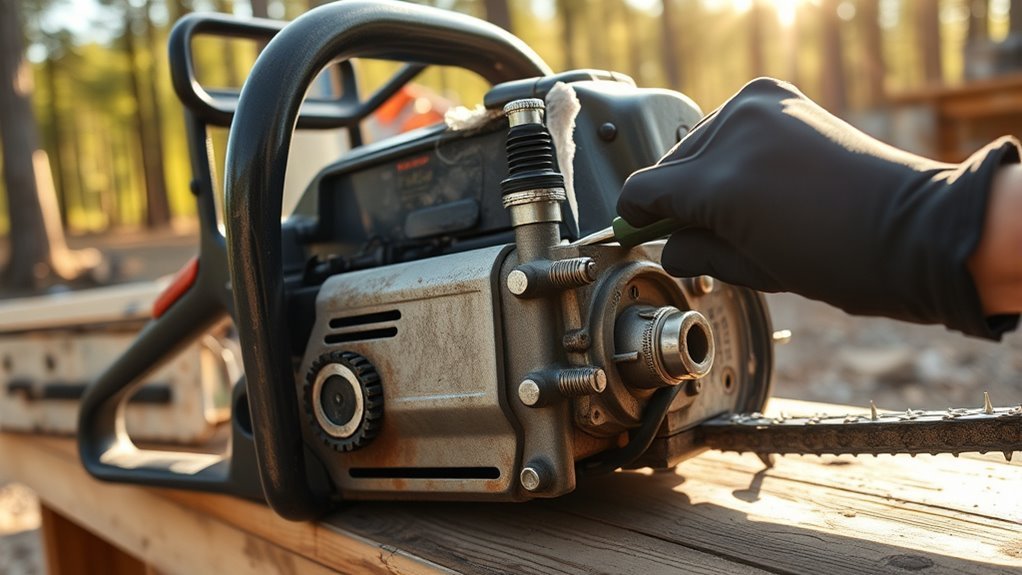
Once you start the chainsaw, pull the starter cord several times until the engine runs smoothly to warm it up properly. You need to warm up the chainsaw engine by letting it idle on a stable surface for about five minutes.
This ensures the engine reaches its peak operating temperature and prevents inaccurate carburetor adjustments. While warming up, avoid revving the engine aggressively; doing so can cause unnecessary wear and lead to poor tuning results.
Make sure the chainsaw is placed securely to avoid accidents during this process. Confirm that the engine temperature is steady before moving on.
Taking these steps helps you achieve precise carburetor adjustments and extends the life of your chainsaw’s engine.
Locate and Identify Carburetor Adjustment Screws

Where can you find the carburetor adjustment screws on your chainsaw? These small screws are usually located on the side or bottom of the carburetor body.
Before you start, make sure the engine is off to avoid injury. Good lighting and a magnifying glass can help you spot the tiny screws and their markings.
You’ll see labels like “L” for low-speed, “H” for high-speed, and “T” or “LA” for idle or throttle settings. Use a flathead screwdriver or a Husqvarna carburetor adjustment tool to identify and turn these carburetor adjustment screws carefully.
| Screw Label | Function |
|---|---|
| L | Low-speed fuel |
| H | High-speed fuel |
| T or LA | Idle or throttle |
| – | Location: side/bottom |
Adjust Low-Speed and Idle Screws
After locating the carburetor adjustment screws, focus on the “L” screw, which controls the fuel mixture at low speeds and idle. Turn the “L” screw clockwise to lean the mixture or counterclockwise to enrich it, making small adjustments.
Next, adjust the idle screw to set a stable engine speed where the chain stays still without stalling. Fine-tune the “L” screw until the engine runs smoothly and responds well at low throttle.
Always pause after each tweak to observe how the engine performs before changing anything else. These careful adjustments guarantee your chainsaw runs efficiently at low speed, improving performance and preventing stalling during idle.
Taking your time here makes the next steps easier and more effective.
Fine-Tune High-Speed Screw and Test Performance
How do you achieve peak chainsaw performance at high speeds? Start by turning the high-speed “H” screw clockwise to lean the mixture or counterclockwise to enrich it. Make small adjustments of about 1/8 turn each time.
After every tweak, rev the engine to half throttle and listen closely. If you notice hesitation, sputtering, or bogging down, the mixture needs more tuning. Keep fine-tuning the “H” screw until the engine reaches a stable, maximum RPM without knocking or excessive noise.
Once you get the performance you need, gently tighten the screw to lock the setting. Finally, test your chainsaw at full throttle to ensure it runs smoothly and delivers the best performance you need for demanding tasks.
Frequently Asked Questions
How Do You Adjust a Carburetor on a Chainsaw?
You adjust your chainsaw carburetor by turning the “L,” “H,” and “T” screws with a screwdriver. Warm the engine first, then tweak these screws to balance idle, low-speed, and high-speed performance smoothly.
It might take a few tries to get it just right, but don’t rush. Just make small adjustments and listen to how the engine responds.
Why Does My Chainsaw Bog Down When I Give It Gas?
Your chainsaw bogs down when you give it gas because the carburetor’s fuel-air mix is likely off, fuel flow might be blocked, or the spark plug is misfiring. These issues choke engine power and cause sluggish acceleration.
It’s like the engine isn’t getting what it needs to rev up properly. Checking these parts can usually get your chainsaw running smooth again.
How Do I Set My Carburetor to Factory Settings?
You’ll turn the “L” and “H” screws clockwise until they gently seat, then back them out 1 to 1.5 turns.
Always warm up your chainsaw first and check your manual for model-specific settings.
This helps ensure your carburetor is set correctly for optimal performance.
If you’re unsure, it’s a good idea to consult a professional or the manufacturer’s guidelines.
How Do You Adjust the Carb on a Stihl Trimmer?
You know what they say: “Measure twice, cut once.”
To adjust your Stihl trimmer carb, first warm it up. Then, tweak the “L,” “H,” and “T” screws carefully.
This will help you get a smooth idle and ideal performance.
Conclusion
Now that you’ve given your chainsaw’s carburetor a little TLC, you’re all set for smoother, more efficient cuts. Remember, a well-tuned carb means your saw isn’t just working harder—it’s working smarter.
Keep an eye on performance, and don’t hesitate to make small tweaks as needed. With these gentle adjustments, you’re not just maintaining your tool; you’re giving it a fresh breath of life for every job ahead.
Adjusting your chainsaw carb properly ensures optimal fuel mixture and engine performance. This helps prevent issues like stalling or rough idling, making your chainsaw more reliable. In short, regular carb adjustments mean your chainsaw runs smoothly, lasts longer, and cuts better every time you use it.